


Negotiating the NDIS can often be overwhelming and stressful!
Joy Ward – (PHYSIOTHERAPIST)
SPECIAL INTEREST IN MOVEMENT DISORDERS
The NDIS (National Disability Insurance Scheme) was progressively rolled out in 2016 to help improve care and supports that people with disabilities receive. It is federally funded but managed by Local Governing Areas (LGAs).
NDIS funding is not automatically given to you. See our diagram below to better understand the different steps involved to access then navigate the NDIS
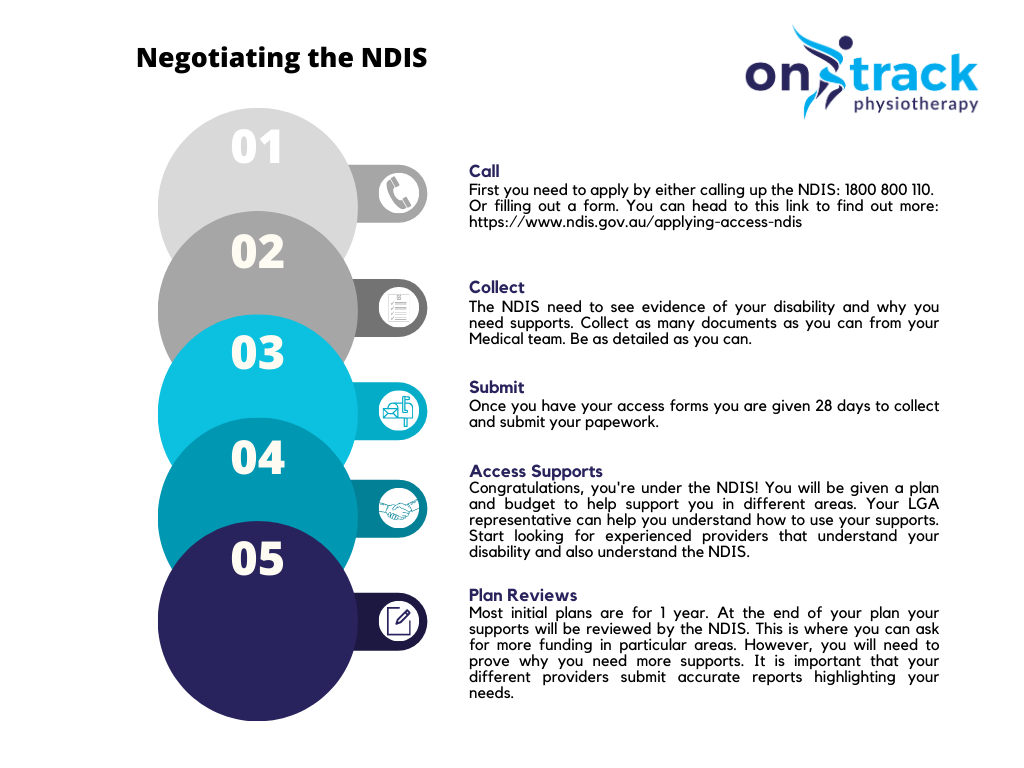
Top Tips:
- Be a Strong Advocate for yourself. Explain the level of supports you need on your worst day NOT your best day!
- Try and get a Support person that can support you in meetings, help with getting paperwork organised and even help you with finding supports
- Don’t be afraid to ask for help! Make use of your Providers (therapists, doctors etc.) Call your local LGA representative and ask questions.
- When applying for funding, focus on ‘Capacity and Function’ i.e. what you are able to do more of independently IF you had x,y,z supports.
Supporting Documentation
The NDIS is an insurance scheme after all and you need to prove how effective the funding you were given was. Any supporting documentations should have quantitative and qualitative measures showing either improvements with funding, decline in your function and/or maintenance of your condition because of the supports.
If you are not happy with your funding allocation you can request for a review. Also, if you have a sudden change or your circumstances e.g. illness, break-up in relationship, moving to a different state you can apply for an early review of your plan citing ‘changes in circumstances’.
When applying for complex equipment such as wheelchairs, scooters, commodes etc. you will need an experienced Occupational Therapist and Physiotherapist to run trials for you and then submit what we call an Assistive Technology request.

